
Home > Temple grounds guide

Please use this as a guideline.
From the Niomon Gate to the main hall
Approximately 150 m, 5 minutes on foot
From the first parking lot to the main hall
Approximately 300 m ( 15 minutes on foot)
From the second parking lot to the main hall
Approximately 350 m ( 17 minutes on foot)
Time required for worship
Approximately 30 minutes
*When heading to the main hall from the first parking lot
*Click to enlarge.
Main Hall
Gifu Prefecture designated important cultural property
The main hall is a five-bay, four-sided gabled roof with a cypress bark roof, and is built on a rocky mountain on the slope at the top of the mountain.
The front of the temple is built like a stage and is very similar to Kiyomizu-dera Temple in Kyoto, and it is known to the world as Mino-shimizu.
The main hall, donated by the Kamakura nun shogun Hojo Masako, was unfortunately burned down during the Onin War, and the current main hall was built in 1661 (during the Edo period).

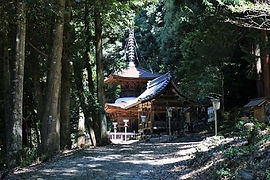
Tahoto Pagoda
Nationally designated important cultural property
During the reign of the Kamakura Nun Shogun (Hojo Masako), there was a great drought throughout the country and no grains could be harvested.One night, the nun was dreaming when out of nowhere a divine dragon appeared and said, "There is a pond at Nichiryuho-ji Temple. If you copy the Lotus Sutra, make an offering, and then enter the pond, a heavy rain will immediately fall."She woke up seeing the dragon fly into the pond.
The nun ordered a monk named Doun to copy out the ten volumes of the Lotus Sutra, offer it as an offering, and place it in the pond where she prayed. Suddenly, a miraculous rain fell and the five grains ripened. As a token of gratitude, the Shogunate restored all seven of the temple buildings, which had fallen into disrepair, and awarded the temple 80 cho of land as its territory.
This pagoda is the only structure built by the Shogun family, and was designated a special national protected structure in 1894 and an important cultural property in 1950.It is one of the most representative structures in the country from the Kamakura period and is a cultural relic that is approximately 800 years old.

Bell Tower
The building before it was rebuilt in 1936 burned down in 1931. Visitors are welcome to ring the bell at any time (no request needed).
Many visitors come to ring the bell during the New Year holidays .


Fudodo
Built in 1795, it is located halfway up the east approach and is a training center for ascetic monks.
A statue of Acala is enshrined here.
Yakushido
It was built in the fifth year of the Jokyo era and is said to have formerly been located on Omotesando, Yakushigaoka.
The temple houses a seated statue of Yakushi Nyorai, Nikko Bodhisattva, and Gakko Bodhisattva.


Konpira Hall
Built in 1816, it is a beautiful, well-organized structure donated by the ancestors of the Mamechiyo family.
Hakusan Shrine
The one-bay, nare-style shrine is roofed with cypress bark and was built in 1533.
At the end of the Muromachi period, the building already had a Momoyama-style color scheme and is a beautiful, clean-lined building.


Komorido (Basket Hall)
Built in 1811, it evokes the prosperity of the temple in the past. It is an important cultural property designated by Gifu Prefecture.
*A kagodo is a hall where believers and ascetics stay to pray and practice.
Niomon Gate
Built in the third year of the Kyoho era, it houses a set of Kongorikishi statues in the typical Edo style.
The ceiling paintings from the Edo period are magnificent. There are 300 steps leading from the Niomon Gate to the main hall.


Reception hall
Dainichisan Nichiryuhoji Temple was under the direct control of the Owari Temple and Shrine Service, and until the Meiji government, Dainichibo and Tokobo took turns managing and operating the temple.
The temples merged in the early Meiji period, and in 1876 a large guest hall covering several hundred tsubo was built at the Tokobo site.

Sacred Thousand Cypress Trees
The cypress walking stick used by Ryomen Sukuna as a climbing stick is a rare sacred tree with a thousand branches and leaves, evoking the appearance of a bygone era.
Mitarashi sacred water
This sacred water springs from a cave behind the main hall.
It is said to be particularly effective for eye diseases, preventing dementia, fertility, and curing illness.


宝筺印塔(ほうきょういんとう)
Built in 1333. Designated an Important Cultural Property by Gifu Prefecture. It is said that some of Minamoto no Yoritomo's bones were buried inside the pagoda.
The four seasons of Takazawa Kannon
spring

-min_JPG.jpg)
-min_JPG.jpg)
summer
-min_JPG.jpg)
-min_JPG.jpg)
-min_JPG.jpg)
autumn
-min_JPG.jpg)
-min_JPG.jpg)
-min_JPG.jpg)
-min_JPG.jpg)
-min_JPG.jpg)
-min_JPG.jpg)
-min_JPG.jpg)
-min_JPG.jpg)
-min_JPG.jpg)
-min_JPG.jpg)
-min_JPG.jpg)
